

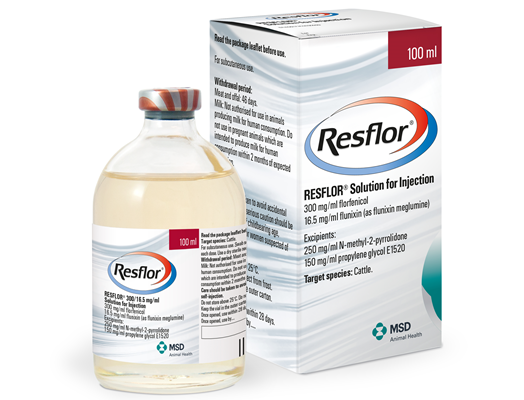
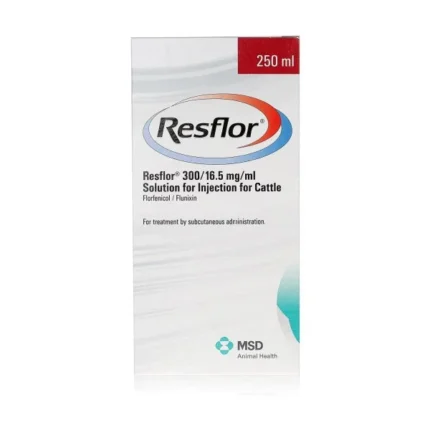
Resflor Injection 100ml
Original price was: $80.00.$70.00Current price is: $70.00.
Resflor 100ml Treatment of respiratory infections caused by Mannheimia haemolytica, Pasteurella multocida, Resflor 100ml Mycoplasma bovis and Histophilus somni associated with pyrexia. Resflor contains Florfenicol and Flunixin to provide an antibiotic and anti inflammatory and anti pyrexic in one dose.
Resflor Injection 100mL – Powerful Advanced Cattle Respiratory Support
Resflor Injection 100mL commonly refers to RESFLOR GOLD, an injectable veterinary medicine combining florfenicol and flunixin meglumine. The U.S. FDA-approved formulation contains 300 mg florfenicol and 16.5 mg flunixin per mL and is supplied in 100mL, 250mL and 500mL vials. It is indicated for treatment of bovine respiratory disease (BRD) associated with Mannheimia haemolytica, Pasteurella multocida, Histophilus somni, and Mycoplasma bovis, and for control of BRD-associated fever in beef and non-lactating dairy cattle.
Because veterinary registrations can differ between countries, always verify the exact Resflor Injection 100mL formulation and current local label before use.
What Is Resflor Injection 100mL?
Resflor Injection 100mL is a combination veterinary injectable containing an antimicrobial and an NSAID.
The two active ingredients in RESFLOR GOLD are:
- Florfenicol – an antimicrobial used against susceptible bacterial pathogens.
- Flunixin meglumine – a non-steroidal anti-inflammatory drug (NSAID) used to control fever associated with BRD.
The FDA classifies RESFLOR GOLD as an antimicrobial and NSAID injectable solution.
Product Overview
| Product Detail | Information |
|---|---|
| Product | Resflor / RESFLOR GOLD |
| Presentation | 100mL |
| Form | Injectable solution |
| Florfenicol | 300 mg/mL in U.S. formulation |
| Flunixin | 16.5 mg/mL in U.S. formulation |
| Target species | Beef and non-lactating dairy cattle |
| Primary indication | Bovine respiratory disease |
| Route | Subcutaneous under U.S. labeling |
| Veterinary status | Prescription product in the U.S. |
Table of Contents
- What Is Resflor Injection 100mL?
- Resflor for Cattle
- Florfenicol and Flunixin Meglumine
- Resflor for Bovine Respiratory Disease
- Signs of BRD in Cattle
- Resflor Injection Dosage and Administration
- Safety and Precautions
- Responsible Antibiotic Use
- Withdrawal Considerations
- Storage and Handling
- Where To Buy Resflor Injection 100mL Online
- Frequently Asked Questions
Resflor for Cattle
Resflor Injection 100mL is intended for cattle under the applicable product authorization.
Bovine respiratory disease is influenced by infectious organisms as well as environmental and management factors. Stress from transportation, weaning, commingling and changes in housing can increase respiratory-health challenges.
Good cattle-health management should therefore include:
- Appropriate vaccination
- Good ventilation
- Adequate nutrition
- Clean water
- Appropriate stocking density
- Stress reduction
- Biosecurity
- Prompt identification of sick cattle
- Veterinary assessment when necessary
Florfenicol and Flunixin Meglumine
The combination of florfenicol and flunixin provides two different pharmacological actions.
Florfenicol is the antimicrobial component and acts against susceptible bacterial pathogens.
Flunixin meglumine is an NSAID that helps control fever and inflammation associated with appropriate veterinary indications.
The combination does not mean that every respiratory illness will respond to Resflor. Proper diagnosis and appropriate antimicrobial selection remain important.
Resflor for Bovine Respiratory Disease
The U.S. RESFLOR GOLD label identifies BRD associated with Mannheimia haemolytica, Pasteurella multocida, Histophilus somni, and Mycoplasma bovis as approved treatment indications in beef and non-lactating dairy cattle.
Respiratory disease may be associated with:
- Coughing
- Fever
- Nasal discharge
- Increased respiratory effort
- Depression
- Reduced appetite
- Reduced activity
- Poor growth
- Abnormal breathing
Cattle with significant or worsening respiratory signs should be evaluated by a veterinarian.
Signs of BRD in Cattle
Early recognition of bovine respiratory disease can be important for individual-animal and herd management.
Producers should monitor for changes in:
Breathing: coughing, rapid breathing or increased respiratory effort.
Temperature: fever may accompany infectious respiratory disease.
Appetite: affected cattle may eat less.
Behavior: sick animals may become depressed or separate themselves from the herd.
Nasal discharge: respiratory infection can produce nasal secretions.
These signs should be considered together with the animal’s history and clinical findings rather than being used alone to determine treatment.
Resflor Injection 100mL Dosage and Administration
The exact dosage must always be confirmed against the current label for the specific product and country.
For the U.S. RESFLOR GOLD formulation, the labeled dose is 40 mg florfenicol/kg body weight plus 2.2 mg flunixin/kg body weight once, equivalent to 2mL per 15kg (6mL per 100lb). The U.S. label specifies subcutaneous administration and limits the volume to 10mL per injection site.
The 100mL bottle is the package size and is not a single-animal dose.
Do not use the U.S. dosing information for a different international formulation unless the applicable product label confirms that it is appropriate.
Safety and Precautions
Resflor combines an antimicrobial with an NSAID, making veterinary oversight particularly important.
The FDA reported a safety-label update in October 2024 concerning reproductive and periparturient precautions. The updated labeling states that the product is not for use in animals intended for breeding purposes and warns of potential effects associated with flunixin around calving, including delayed parturition and prolonged labor.
Before treatment, discuss the animal’s:
- Pregnancy status
- Reproductive status
- Medical history
- Current medicines
- Hydration status
- Previous antimicrobial treatment
- Severity of respiratory disease
Responsible Antibiotic Use
Because florfenicol is an antimicrobial, responsible use is essential.
Good antimicrobial stewardship includes:
- Veterinary diagnosis
- Appropriate antimicrobial selection
- Correct dosing
- Correct administration
- Following the applicable label
- Maintaining treatment records
- Monitoring treatment response
- Reassessing animals that fail to improve
Unnecessary antimicrobial use can contribute to antimicrobial resistance.
Withdrawal Considerations
Resflor is used in food-producing cattle, so withdrawal requirements are particularly important.
Withdrawal periods are product- and jurisdiction-specific. Do not rely on a withdrawal period copied from another country or another florfenicol product.
The current local label should be followed for meat and other food-safety requirements.
Storage and Handling
Store Resflor Injection 100mL according to the manufacturer’s current instructions.
Before use, inspect:
- Product name
- Active ingredients
- Concentrations
- Expiration date
- Bottle integrity
- Storage conditions
- Solution appearance
Do not use an injectable product that is expired, damaged or improperly stored.
Where To Buy Resflor Injection 100mL Online
If you are looking to buy Resflor Injection 100mL online, verify the exact formulation and regulatory status before ordering.
Equnes Vet provides information for customers researching cattle medicines, livestock antibiotics and veterinary injectable products.
Before purchasing, confirm:
- Resflor Injection 100mL
- Whether it is RESFLOR GOLD
- Florfenicol concentration
- Flunixin concentration
- Manufacturer
- Approved cattle indications
- Expiration date
- Storage requirements
- Prescription requirements
- Applicable withdrawal information
In the United States, RESFLOR GOLD is a prescription veterinary product.
Frequently Asked Questions
What is Resflor Injection 100mL?
Resflor Injection 100mL commonly refers to RESFLOR GOLD, a combination injectable containing florfenicol and flunixin meglumine for specific bovine respiratory disease indications.
What is Resflor used for?
The U.S. product is indicated for treatment of certain bacterial causes of bovine respiratory disease and control of associated fever in beef and non-lactating dairy cattle.
What are the active ingredients in Resflor?
The U.S. RESFLOR GOLD formulation contains 300 mg/mL florfenicol and 16.5 mg/mL flunixin.
Is Resflor an antibiotic?
Yes. Florfenicol is the antimicrobial component. Flunixin meglumine is an NSAID.
What is the dosage of Resflor Injection 100mL?
For the U.S. RESFLOR GOLD formulation, the labeled dose is 2mL per 15kg body weight once, administered subcutaneously, with no more than 10mL at an injection site.
Can Resflor be used for every case of bovine respiratory disease?
No. BRD can have multiple causes, and treatment should be based on veterinary diagnosis and the approved indication.
Is Resflor suitable for breeding cattle?
The current U.S. labeling contains reproductive precautions and states that RESFLOR GOLD is not for use in animals intended for breeding purposes.
Where can I buy Resflor Injection 100mL online?
When purchasing online, verify the exact formulation, manufacturer, expiration date, prescription status and applicable veterinary regulations and withdrawal requirements.
Resflor 100ml Treatment of respiratory infections caused by Mannheimia haemolytica, Pasteurella multocida, Resflor 100ml Mycoplasma bovis and Histophilus somni associated with pyrexia. Resflor contains Florfenicol and Flunixin to provide an antibiotic and anti inflammatory and anti pyrexic in one dose.Resflor 100ml
Resflor 300/16.5 mg/ml Solution for Injection for Cattle.
Qualitative and quantitative composition
For a full list of excipients, see section “Pharmaceutical Particulars”.
Pharmaceutical form
Solution for injection. Clear, light yellow to straw coloured liquid.
Clinical particulars
Target species
Cattle
Indications for use
Curative treatment of respiratory infections caused by Mannheimia haemolytica, Pasteurella multocida and Histophilus somni associated with pyrexia.Resflor 100ml
Contra-indications
Do not use in adult bulls intended for breeding purposes. Do not use in animals suffering from hepatic and renal diseases. Do not use if there is a risk of gastrointestinal bleeding or in cases where there is evidence of altered haemostasis. Do not use in animals suffering from cardiac diseases. Do not use in the case of known hypersensitivity to active substances or to any of the excipients.
Special warnings for each target species
None.
Special precautions for use
The product should be used in conjunction with susceptibility testing and take into account official and local antimicrobial policies. Avoid use in dehydrated, hypovolaemic or hypotensive animals as there is a potential risk of increased renal toxicity. Concurrent administration of potentially nephrotoxic drugs should be avoided.
Repeated daily dosing has been associated with abomasal erosions in the pre-ruminant calf. The product should be used with caution in this age group. The safety of the product has not been tested in calves of 3 weeks of age or less.
Operator warnings
Care should be taken to avoid accidental self-injection. Wash hands after use. Do not use the product in known cases of sensitivity to propylene glycol and polyethylene glycols.
Adverse reactions
Subcutaneous administration of the product may result in injection site swellings that become palpable 2-3 days after injection. The duration of the injection site swellings ranged from 15-36 days post-injection. Grossly, this is associated with minimal to mild irritation of the subcutis. Extension into the underlying muscle was noted in only a few instances. By 56 days post-dosing, no gross lesions were observed that would require any trim-out at slaughter.
Use during pregnancy, lactation or lay
The effect of florfenicol on bovine reproductive performance, pregnancy and lactation has not been assessed. Use only accordingly to the benefit/risk assessment by the responsible veterinarian.
Interactions
Concurrent use of other active substances that have a high degree of protein binding may compete with flunixin for binding and thus lead to toxic effects. Pre-treatment with other anti-inflammatory substances may result in additional or increased adverse effects and accordingly a treatment-free period with such drugs should be observed for at least 24 hours before the commencement of treatment. The treatment-free period, however, should take into account the pharmacokinetic properties of the products used previously. The product must not be administered in conjunction with other NSAIDs or glucocorticosteroids. Gastrointestinal tract ulceration may be exacerbated by corticosteroids in animals given NSAIDs.
Amounts to be administered and administration route
40 mg/kg florfenicol and 2.2 mg/kg flunixin (2 ml/15 kg body weight) to be administered by a single subcutaneous injection. To ensure correct dosage and avoid under dosing, bodyweight should be determined as accurately as possible. The dose volume given at any one injection site should not exceed 10 ml. It is recommended to treat animals in the early stages of the disease and to evaluate the response to treatment 48 hours after injection. The anti-inflammatory component of Resflor, flunixin, may mask a poor bacteriological response to florfenicol in the first 24 hours after injection. If clinical signs of respiratory disease persist or increase, or if relapse occurs, treatment should be changed, using another antibiotic, and continued until clinical signs have resolved. The injection should only be given in the neck. Swab septum before removing each dose. Use a dry sterile needle and syringe.



Reviews
There are no reviews yet.